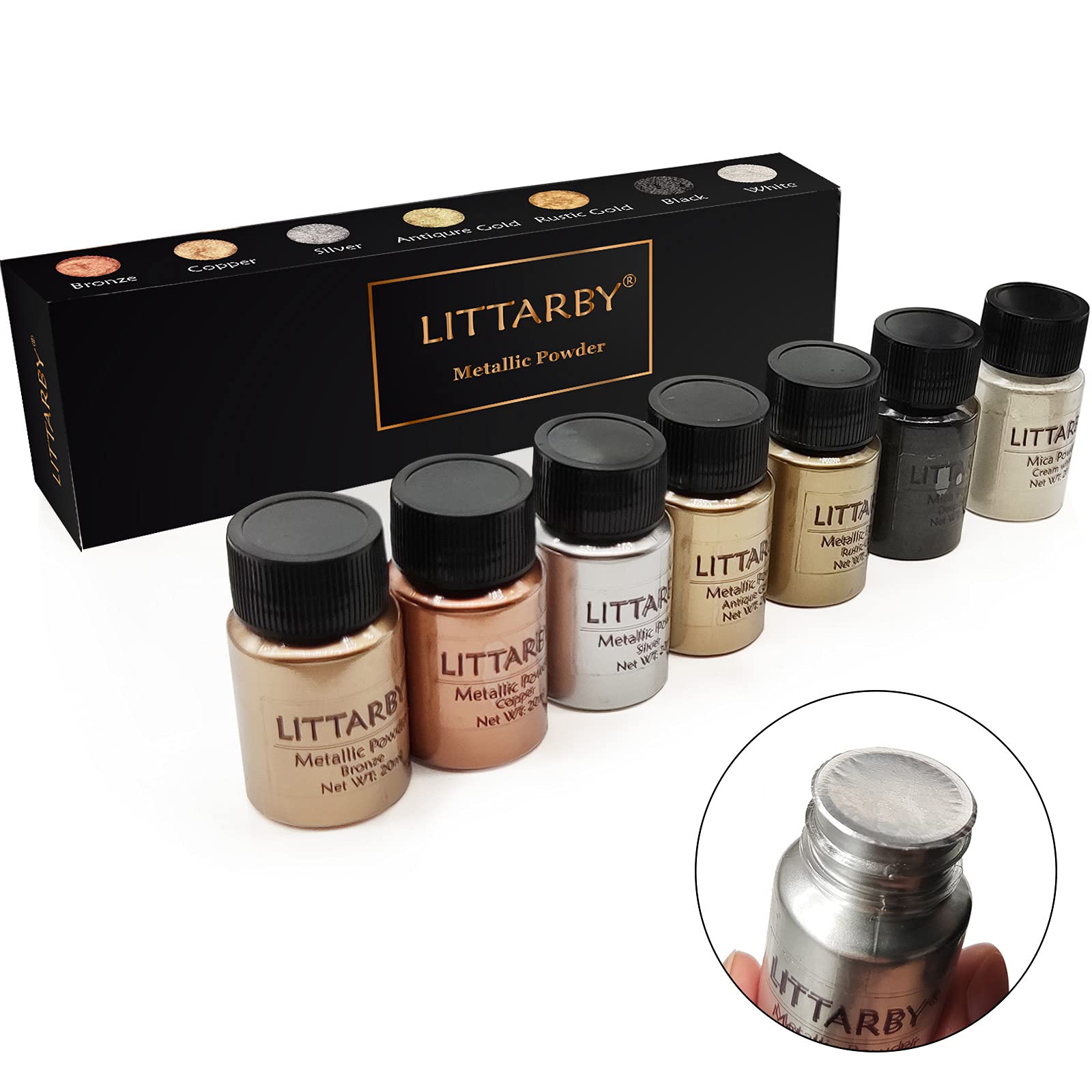
When working with epoxy resin, the choice of colorant can significantly affect the final look and handling. This set of metallic pigment powders, including copper, silver, gold, black, and pearl white mica, is marketed for use in resin, but also for kintsugi, painting arts, polymer clay, and countertops. After testing these powders in several resin pours and a polymer clay project, I have a clearer picture of what they do well and where they fall short.
The powders are fine and dust-like, which makes them easy to mix into epoxy resin without clumping. I found that a small amount goes a long way; about half a teaspoon per 100ml of resin gave a vibrant, metallic sheen. The copper and gold shades are particularly rich and warm, while the silver and black are more neutral. The pearl white is subtle and works well as a base or for creating a soft shimmer. In terms of key functional features, these are dry mica powders, not pre-dispersed pastes, so they require thorough stirring to avoid streaks. They hold up well during curing, with no noticeable fading or bleeding, and the metallic effect remains after sanding and polishing, which is important for items like trays or countertops.
However, there are limitations. The particle size, while fine, is not as uniform as some higher-end brands. In one resin pour, I noticed slight speckling in the silver shade, likely due to larger particles settling. This might be acceptable for textured or rustic projects, but for a smooth, mirror-like finish, it could be a drawback. Additionally, the powders are not suitable for use in high-heat applications; they are intended for room-temperature curing only. If you plan to use them near heat sources, like on a countertop near a stove, they may degrade over time.
Comparing these to liquid resin dyes or alcohol inks, the difference is clear. Liquid dyes offer transparency and can create gradients, while these mica powders provide opacity and a metallic, reflective finish. They are more similar to cosmetic-grade mica powders but lack the same level of purity and consistent particle size. For kintsugi, the gold powder works adequately, but it does not achieve the same luminous depth as traditional gold leaf; it is more of a flat metallic substitute. For painting arts or polymer clay, the powders mix well with mediums like clear gesso or polymer clay softener, but they can be messy to handle due to their lightweight dustiness.
Who should consider this product? It is best suited for hobbyists and DIYers working on resin coasters, small trays, jewelry, or casual art projects. It is also a reasonable choice for beginners exploring metallic effects without committing to expensive specialty pigments. For kintsugi repairs, it is a budget-friendly alternative to real gold, but results will be less refined.
Who might want to look elsewhere? Professional resin artists needing consistent particle size for high-gloss, flawless finishes should invest in higher-grade mica powders. Those working on large countertops or surfaces that require high heat resistance or food-safe certification should also skip this set, as it lacks those certifications. Similarly, if you need transparent metallic effects, alcohol inks or resin dyes would be a better fit.
In summary, this set of metallic pigment powders delivers decent results for its price point, with good color payoff and versatility across several crafts. The main trade-offs are inconsistent particle size and lack of heat resistance, which limit its application in professional or high-stakes projects. If you accept these limitations, it is a functional option for adding metallic accents to resin and clay work.