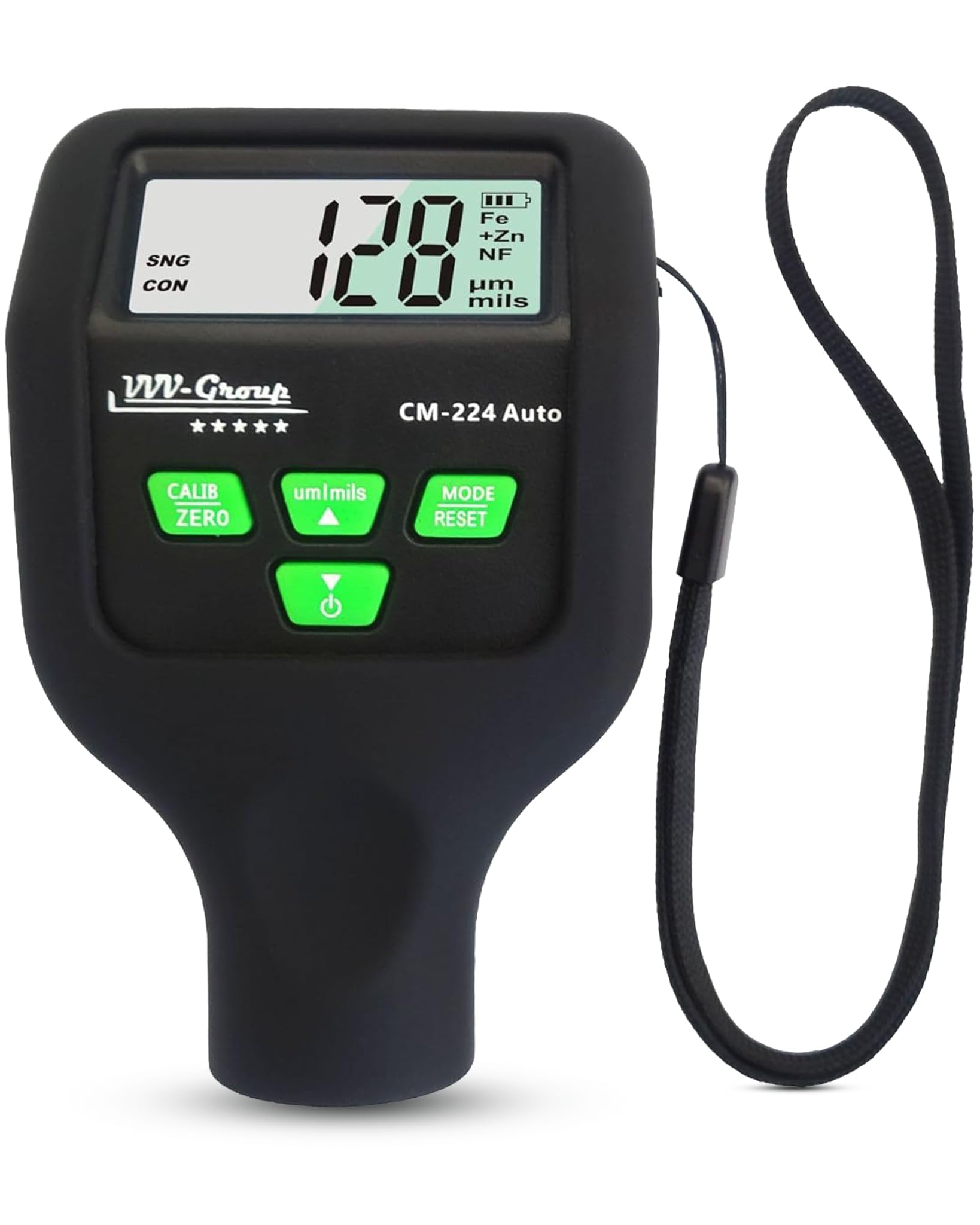
The CM-224 Auto paint thickness gauge is a digital coating thickness meter designed primarily for automotive use, targeting car enthusiasts, detailers, and used car inspectors. It measures paint thickness on ferrous (Fe), non-ferrous (Al), and Fe+Zn substrates, offering a resolution of 0.1 μm. In practice, it is used to check for repaints, body filler, or rust repairs on vehicles, helping assess paint consistency and potential hidden damage. The device is factory calibrated and features a large backlit LCD, making it usable in dimly lit garages or under a car hood.
Key features include automatic substrate detection (Fe/Al/Fe+Zn), a measurement range up to 2000 μm, and a simple one-button operation. The probe is built into the unit, which is common for handheld gauges. The backlit screen is helpful for reading results in low light, and the auto-calibration means you can start measuring right out of the box without manual adjustments. However, the factory calibration is a double-edged sword: while convenient, it may drift over time or with heavy use, and there is no user calibration option to compensate for this. This limitation means the readings might become less accurate after extended use, potentially requiring a return to the manufacturer for recalibration.
Compared to more advanced models like the PosiTector series, the CM-224 lacks data logging, statistical analysis, or Bluetooth connectivity. Those are higher-end features for professional paint shops or quality assurance labs. The CM-224 is simpler and more affordable, making it a reasonable choice for hobbyists or small shop use, but it may not satisfy professionals who need traceable measurements or batch reporting. Another trade-off is the probe’s design: it is fixed and somewhat bulky, which can make it tricky to measure tight curves or edges on car panels, such as around door handles or on motorcycle tanks. You may need to take multiple readings to get a consistent average on uneven surfaces.
Real-world performance is generally reliable for typical automotive inspections. On a flat, clean metal panel, the gauge gives repeatable readings within a few microns. But on rough or textured surfaces (like orange peel paint), the readings can vary by 10–20 μm, so it is best to take several measurements and average them. The automatic substrate detection works well on standard steel and aluminum, but on zinc-coated or mixed materials, it can occasionally misidentify the base, leading to a reading error. In such cases, manually selecting the substrate mode would be helpful, but the CM-224 does not offer that option—it is fully automatic.
Who is this gauge suitable for? It is a good fit for used car buyers who want a quick check for repaints, or for car detailers who need to verify paint thickness before polishing. It is also useful for entry-level automotive inspectors. However, it is not ideal for professionals who require high accuracy on complex surfaces, or for those who need to document measurements over time. If you need data export or multi-point averaging, you should look at higher-tier models. Also, if you work with non-metallic substrates like carbon fiber or plastic, this gauge will not work at all—it only measures on metal.
Overall, the CM-224 Auto is a competent but basic tool. It does its job for straightforward paint thickness checks on cars, but its lack of user calibration and limited substrate handling are notable drawbacks. For the price, it offers decent value, but don’t expect it to replace a lab-grade instrument. If your needs are simple and occasional, it will serve you well. If you need precision or versatility, you might find it frustrating.