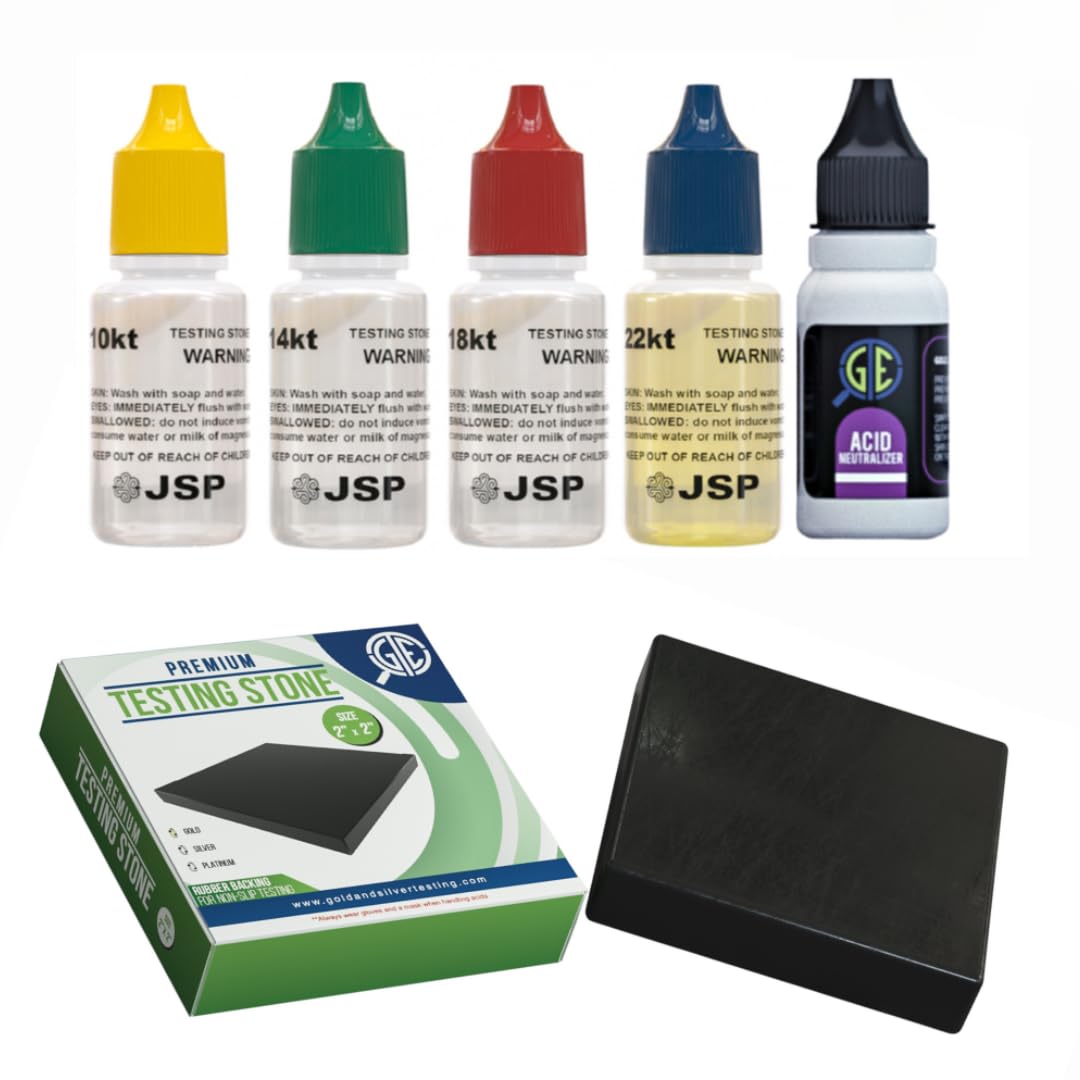
The Gemtone Gold Testing Jewelry Kit is a set of acid-based solutions designed to help determine the purity of gold items, from 10K up to 22K. It is marketed as a tool for jewelers, pawnbrokers, and serious hobbyists who need a quick, reliable method to assess gold content without sending pieces to a lab. This review looks at how the kit performs in real-world use, its strengths, and its limitations.
In practice, using the kit involves scratching the gold item on a testing stone to leave a small mark, then applying the corresponding acid solution to see if the mark dissolves. The process is straightforward but requires careful attention to safety and technique. The kit includes separate bottles for 10K, 14K, 18K, and 22K testing, each clearly labeled. The acids are formulated to react with specific gold alloys, so a mark that remains intact after applying the 14K solution, for example, indicates the gold is at least 14K. If it dissolves, the purity is lower. This scratch-and-acid method is a standard approach used by many professionals, and Gemtone’s solutions appear to be consistent with industry norms.
Key functional features of the kit include the use of high-purity acids made in the USA, which is a plus for those concerned about quality control. The bottles come with dropper tips for controlled application, and the labeling is durable enough to withstand repeated handling. The kit does not include a testing stone or gloves, so those need to be purchased separately if not already owned. This is a typical omission for such kits, but worth noting for first-time buyers.
One limitation is the kit’s focus on yellow gold. While it works well for standard yellow gold alloys, results can be less reliable for white gold, rose gold, or unusual alloys. The acids are formulated for common karat ratings, but variations in alloy composition—such as higher nickel or copper content—can sometimes cause unexpected reactions. Users should not expect 100% accuracy, especially with vintage or mixed-metal pieces. Another trade-off is the need for proper ventilation and safety precautions. The acids are corrosive and emit fumes, so using the kit in a well-ventilated area with protective gear is essential. This is not a toy or a casual testing method; it requires a workspace that can handle chemical use.
Compared to electronic gold testers, the Gemtone kit offers a lower upfront cost and does not require batteries or calibration. Electronic testers can be faster and less messy, but they are more expensive and may struggle with plated items or irregular shapes. The acid test method is more definitive for surface-level purity, but it leaves a small scratch on the item, which may be a concern for delicate or high-value jewelry. For quick verification of scrap gold or less precious pieces, the scratch test is acceptable, but for valuable antiques or sentimental items, a non-destructive method like X-ray fluorescence (XRF) might be preferable, though that is far more costly.
Who is this kit for? It is best suited for individuals who handle gold regularly—such as jewelers, pawnbrokers, gold buyers, or serious metal detectors—and who need a portable, affordable way to verify purity. It also works for hobbyists who recycle scrap gold or test estate sale finds. However, it is not ideal for casual users who only test a few items a year, as the acids have a shelf life and require proper storage. Beginners may find the learning curve steep, especially in interpreting ambiguous results. The kit is also not recommended for testing gold-plated items, as the acid will eat through the plating and give a false reading for the base metal underneath.
Overall, the Gemtone Gold Testing Jewelry Kit delivers on its basic promise: it provides a reliable method for determining gold karat ratings within a limited range. It is a practical tool for those who understand its limitations and work in appropriate conditions. For the price, it is a reasonable entry point into acid testing, but users should supplement it with a good testing stone, safety equipment, and a bit of practice. It is not a flawless solution, but it does the job for most common gold testing scenarios.